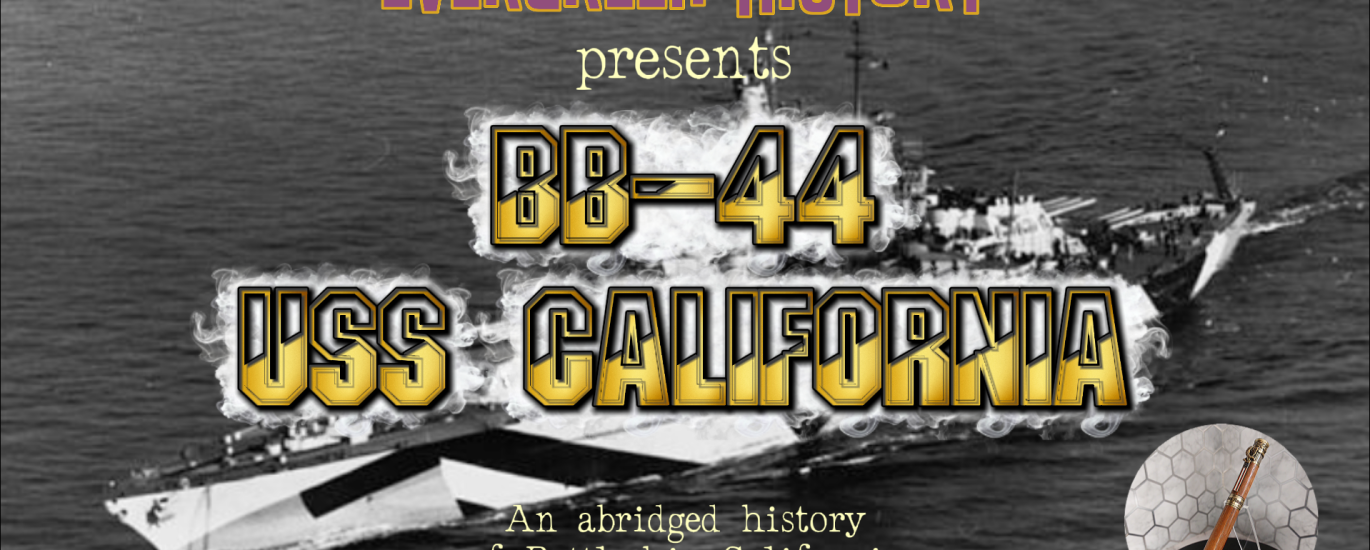
Hello, this is Carl Meyers from Evergreen History, Wood turner and history teacher. After receiving a reclaimed teak wood blank from the deck of the USS California, I was inspired to make a brief history of the Battleship California.
BB-44 USS California was the second of two Tennessee-Class Battleships. Her keel was laid down in October of 1916 and launched on November 20th, 1919. While she missed the war to end all wars, she would see action in the second World Team Death Match. Prior to that she would often act as the Flagship in the Pacific fleet during the 1920’s and 30’s. One of the reasons that she was chosen as the Flagship during the 30’s was the more advanced radar that she was equipped with.
California’s armament was impressive for the time that she was new. She was built prior to the restrictions of the Washington Naval Treaty of 1922, which set the maximum size of main guns of battleships to 16 inches and a maximum displacement of 35,000 tons. California would have 4 turrets, each with three 14-inch guns. Subsequent armaments would include fourteen 5-inch guns, four 3-inch guns and 2 torpedo tubes. During World War II, after she was fixed up following the Pearl Harbor attack, she would get an increased air defense protection with 11 quadruple 40-mm Bofors and 6 twin 40-mm Bofors. It also had 43 single 20-mm Oerlikon cannons. Her Displacement was 40,992 tons when fully loaded – though this was small compared to the larger little sisters of the Iowa class with their 58,460 tons and 16-inch main guns. Additionally, the California was a slow ship at 21 knots compared to the faster battleships of the Iowa Class.
A little bit of history for California: She would become the Flagship of the Pacific Fleet during the 1920’s and would hold the role through the bombing at Pearl Harbor. During the Japanese attack on the US naval base in the territory of Hawaii, the USS California was one of the battleships on the Row along with Arizona, Maryland, Nevada, Oklahoma, Pennsylvania, West Virginia and her older sister Tennessee. Like most ships involved, she took several hits including two torpedoes, both of which were below the armor belt. With that damage the ship was able to counter flood, which prevented her from rolling over like what had happened to USS Oklahoma. California would settle at the bottom of the harbor. She would lose 100 sailors but would be able to see action again. She would be drained of water and put in a dry dock at Puget Sound Naval Yard. There she would be repaired and upgraded.
The upgrades would include the aforementioned Anti-Aircraft guns, as well as a more advanced firing system similar to the ones found on the Iowa Class ships. She would be ready to go by January 1944. Just in time to provide shore bombardment during the Marines invasion of Saipan, Guam, and Tinian to take those islands from the hands of the Japanese.
Her most notable action she saw was during the campaign for the Philippines. USS California would participate in the last battleship-on-battleship action in history. World War II would show that Aircraft Carriers dominate in ship-to-ship combat, starting with the Battle of Midway – which is normally considered the turning point in the Pacific Theater.
The Battle of Surigao Strait was the particular battle within the Philippines Campaign that would see the last of battleships slugging it out. In a summary written by Rear Admiral Samuel E. Morison, there was a concern about the type of ammunition that was being carried by the battleships. At this point in the war, the ships were mainly used for shore bombardment, not for ship-to-ship combat. According to Morrison, USS California was carrying 240 AP rounds (or Armor Piercing rounds). These are the preferred ammo for ship-to-ship combat. Shore bombardment, on the other hand, used High Explosive rounds, the majority of the latter shells being used to hit Japanese positions. So these battleships’ magazines consisted of about 23% Armor-Piercing rounds and about 77% High Explosive rounds. Thus, the American Battleships were not as prepared for ship-to-ship combat at this time but would still go out to meet the Japanese Armada. The strategy to compensate for the low quantity of armor-piercing rounds was to wait until targets were between 17,000 and 20,000 yards and hold the AP shells unless an enemy battleship was in range, and use the remaining high explosive rounds for ships smaller than battleships, like cruisers and destroyers.
The Battle Line where the Battleships were positioned would open fire 03:53am on October 25, 1944. Due to having the latest Mark 8 fire control radar, West Virginia, Tennessee and California were the first American Battleships to fire. It is difficult to tell which ship hit what targets. The fleet included many ships, destroyers, cruisers, and even tiny patrol torpedo boats. The Americans would drive off the Japanese force of a combination of battleships, cruisers, and destroyers. The battleships Fuso and Yamashiro would be sunk during this action. Another notable outcome of this battle was the first deliberate use of the Japanese Kamikaze.
As an unfortunate capstone to this battle for the USS California, she would misinterpret an order on cross with her sister Tennessee and receive damage in the collision. California would return for repairs.
She would finish the war as a shore bombardment platform. California herself would be hit by a Kamikaze during the invasion of Lingayen Gulf, January 6, 1945. The Kamikaze would hit a 5-inch turret. Although damage control was deployed, which saved the ship from destruction, 44 men aboard would lose their lives and 155 would be injured.
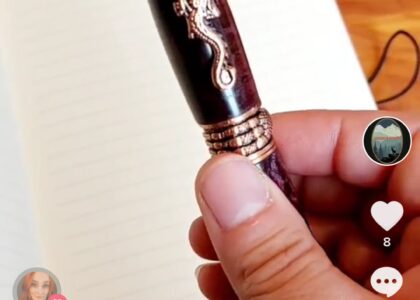
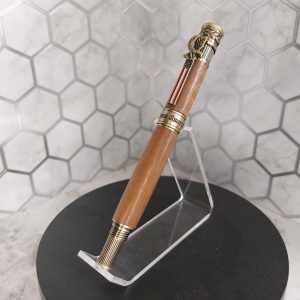
After the war, USS California would spend 12 years in the Reserve Fleet. She would be sold for scrap in July 1959. While most of the ship was lost to being used for other things, her teak deck was sold to Tropical Exotic Hardwoods. It is thanks to this outcome that I was able to use some wood to turn it into a pen.
Sources:
https://www.militaryfactory.com/ships/detail.php?ship_id=uss-california-bb44-battleship#specifications
https://uscs.org/uss-california-bb-44-2/
https://www.history.navy.mil/our-collections/photography/us-navy-ships/battleships/california-bb-44.html
https://en.wikipedia.org/wiki/USS_California_(BB-44)
https://www.usni.org/magazines/proceedings/1958/december/battle-surigao-strait
https://www.warhistoryonline.com/world-war-ii/uss-california.html
https://nationalinterest.org/blog/buzz/battleship-uss-california-how-she-got-revenge-pearl-harbor-185446
https://www.ibiblio.org/hyperwar/USN/ships/logs/BB/bb44-schaffran.html
https://www.usni.org/magazines/proceedings/1958/december/battle-surigao-strait
https://www.loc.gov/resource/ggbain.20127/
https://www.loc.gov/resource/fsa.8e01811/
https://www.maritimequest.com/warship_directory/us_navy_pages/uss_california_bb44_benjamin_turner_collection_page_3.htm
https://www.warhistoryonline.com/world-war-ii/uss-california.html
https://uscs.org/uss-california-bb-44-2/
https://www.history.navy.mil/our-collections/photography/us-navy-ships/battleships/california-bb-44.html